

Every
company needs someone steering the ship. A five-person startup, a family shop,
a multinational with offices on three continents — doesn’t matter. That’s business
management in a nutshell: planning, organizing, staffing, directing, and
controlling an organization’s resources (people, money, materials, information)
so the business actually hits its goals instead of just drifting toward them.
If
you’ve ever typed what is business management into a search bar, here’s
the short answer. It’s about running things well — making sure staff, cash
flow, and daily operations aren’t fighting each other but pulling in the same
direction.
This
guide covers the core functions, the objectives behind them, why any of it
matters, and the different levels you’ll run into at most companies. No filler,
just the practical version.
And
honestly? You don’t need a business degree for most of this. A good chunk of it
is common sense, applied with some discipline. Once you know what to look for,
you start noticing management everywhere — your favorite café, your last job,
even how the corner grocery store restocks its shelves before a weekend rush.
1. Definition: What Is Business
Management?
Strip away the
jargon and business management is just this: directing an organization’s
resources toward a goal. Picture a business with zero management. The resources
are all there — people, cash, inventory — but nobody’s steering. Nothing lines
up. That gap is exactly what management closes. It’s the difference between a
pile of stuff and a functioning company.
Harvard Business
Review has hammered on
this point for years — how well an organization is managed shapes everything
downstream, from the quality of its decisions to how fast it adapts when things
go sideways. So no, it’s not an exaggeration to say business management sits
somewhere near the center of whether a company thrives or just limps along.
2. Core Functions of Business
Management
What does this look
like on a random Tuesday? Five functions cover most of it.
a.
Planning
Setting goals first, then figuring out the
steps to get there. Skip this and everything downstream gets shaky fast.
b. Organizing
Once a plan exists, someone has to
arrange people, tasks, and resources so they don’t trip over each other. This
is roughly where business process management lives too — mapping out
specific workflows, like how an order travels from “purchased” to “delivered,”
and tightening the weak links along the way.
c. Staffing
Putting the right person in the right seat.
Sounds obvious. Plenty of businesses still get it wrong — a strong plan means
little if the people running it aren’t up for the job.
d. Directing/Leading
Motivating people, communicating
clearly, keeping everyone rowing the same direction. This part leans more art
than science, honestly.
e. Controlling
Checking real performance against what
was planned, then correcting course — because reality rarely matches the plan
exactly.
None of these five run in a neat
sequence. In actual businesses they overlap constantly. A manager might be
sketching next quarter’s plan while controlling this week’s numbers at the same
time.
Take a small retail shop gearing up for
the holidays. The owner plans stock levels months ahead, organizes staff shifts
around expected foot traffic, brings on seasonal hires, runs quick morning
briefings so everyone’s on the same page, and checks daily sales against
forecasts to catch problems before they snowball. Drop any one piece and the
whole season can wobble. That’s business management in the wild — not five
separate boxes to check, but one system moving together.
3. Objectives of Business Management
Why bother with any of
this? Usually it comes down to a handful of shared goals.
a. Profit Maximization
No mystery here. A business spending more than it
earns, month after month, doesn’t last.
b. Growth and Expansion
New markets, new products, a bigger slice of the
pie. Often a business development manager is the one chasing this —
someone whose entire job is finding fresh opportunities and partnerships.
c. Efficient Use of Resources
Getting the most out of money, people, and
materials without burning through them needlessly.
d. Customer Satisfaction
Happy customers stick around and tell their
friends. Unhappy ones tell everyone else, unfortunately.
e. Employee Welfare and Motivation
Fair pay, decent conditions, room to
actually grow. People who feel valued tend to care more about the work they do.
f. Social Responsibility
Environmental care, ethical sourcing, giving back
to the community — not just a nice-to-have anymore, but something customers
increasingly expect.
g.
Innovation
Markets shift constantly. Businesses that stop experimenting
eventually get left behind by ones that don’t.
h. Survival and Stability
Weathering downturns, competition, whatever the
economy throws next. This overlaps heavily with business continuity
management — the practice of keeping a company running through disruptions
like cyberattacks, natural disasters, or a supply chain that suddenly falls
apart.
i. Achieving Organizational Goals
At the end of the day, every department
needs to be pulling toward the same mission instead of running its own separate
show.
Quick reference, if that’s easier to
skim:
|
Objective |
What It |
|
Profit Maximization |
Earning more than |
|
Growth and |
New markets, new |
|
Efficient Use of |
Maximum output, |
|
Customer |
Quality that keeps |
|
Employee Welfare |
Fair treatment and |
|
Social |
Ethical, |
|
Innovation |
Staying ahead as |
|
Survival and |
Holding steady |
|
Organizational |
Everyone pulling |
None of this plays out neatly on a
spreadsheet. It’s a constant push-pull between money, people, and staying power
over the long haul.
4. Importance of Business Management
Why does this matter in
practice? A few reasons come up again and again.
a. Ensures Smooth Operations
Fewer bottlenecks. Fewer things quietly
falling through the cracks.
b. Reduces Wastage of Resources
Solid planning means less money spent
cleaning up avoidable mistakes.
c. Improves Productivity
People simply work better when they know what’s
expected of them.
d. Helps Achieve Long-Term Goals
Keeps a business on track across years,
not just whatever this quarter’s numbers say.
e. Builds a Competitive Advantage
Companies that manage themselves well
tend to adapt quicker than the ones scrambling to catch up.
Skip proper management and even a
genuinely good product can fall apart at the seams. Resources get wasted, teams
lose direction, and opportunities that should’ve been obvious slip right past
everyone. People sometimes call management the engine of a business for a
reason — not glamorous work, but nothing else runs without it.
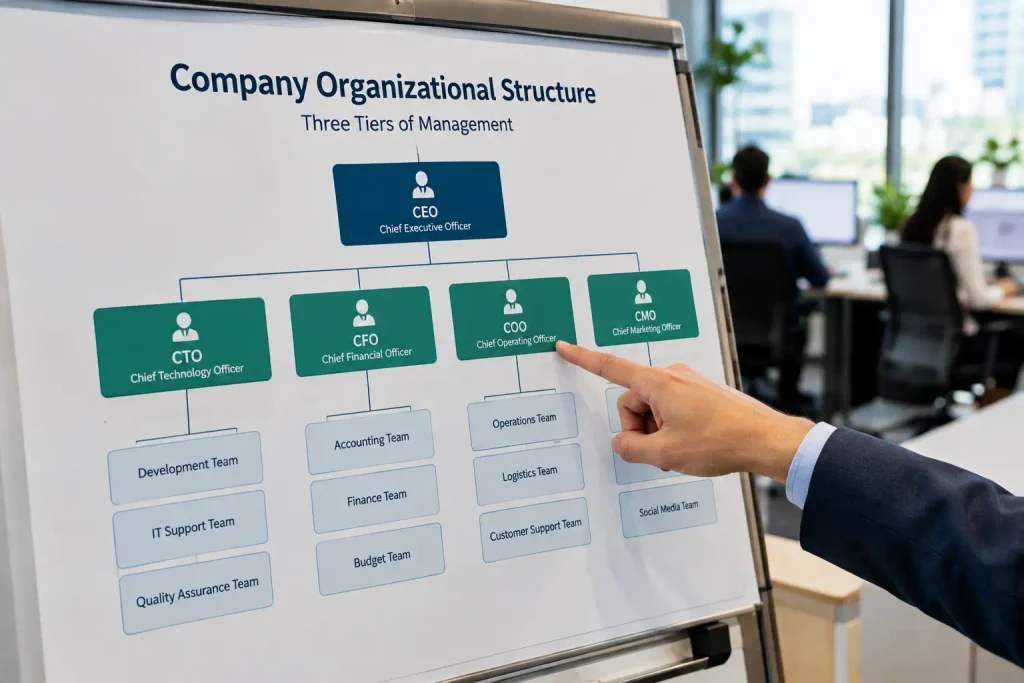
5. Levels of Management
Past a certain size, most
organizations split management into three rough tiers.
a.
Top-Level Management
Board
members, CEOs, senior execs. They’re thinking in years, not weeks.
b.
Middle-Level Management
Department
heads and regional managers. Their job is turning big-picture strategy into
something a team can actually execute on a Monday morning.
c. Lower-Level/Operational
Management
Supervisors
and team leads, handling the daily grind and making sure tasks actually get
done, not just assigned.
1.
Top management sets the
direction.
2.
Middle management builds
the bridge between strategy and execution.
3.
Lower-level management
keeps daily operations moving.
Curious
how this fits into an actual company structure? The U.S.
Small Business Administration’s guide to writing a business plan
is a solid, no-nonsense place to start.
How Technology and Smart Planning
Support Business Management
None of this
happens in a vacuum these days, either. Communication tools, data dashboards,
and automation have reshaped how managers plan and keep tabs on operations.
Curious how that connection plays out in practice? Our piece on how technology
helps business goes further
into it.
And if you’re
still at the idea stage, our roundup of the most
successful businesses to start shows what solid
management actually looks like once it’s put into motion.
Final Thoughts
So, business management boiled down to one
line: it’s what turns plans into results. Planning, organizing, staffing,
directing, controlling — five moving parts, working together rather than
sitting in five separate boxes. And it’s never just about profit. Customer
satisfaction, employee welfare, innovation, staying power — all of it factors
in.
Whether you’re studying this for a class or
actually running a company, understanding these basics gives you a much clearer
read on why some businesses thrive while others quietly come apart. Management
isn’t something you set up once and walk away from. It’s ongoing — a habit,
really, more than a task.
FAQs
1. What do you mean by business management?
Business management is about keeping a company on track. It means figuring out what needs to be done getting the people and resources behind it and checking later to see if it worked out. The main tasks of business management are planning organizing, staffing, leading and controlling.
2. What is the job of a business manager?
A business manager handles things like budgets hiring and monitoring progress. They also make sure teams are communicating and report to their superiors. In a company one person often does all of these tasks. In a company the tasks are divided among different departments.
3. How useful is a business management degree?
A business management degree is pretty useful. It is not a solution that will fix everything but it can help you get a job at a company. You can get an entry-level job in areas like sales, human resources or operations with a business management degree. If you want to specialize in something like finance or marketing you may need to do an internship or get a certification on top of your degree.
4. What jobs can I get if I major in business management?
If you major in business management you can get jobs like operations manager, sales manager, human resources manager, business development manager, financial analyst, marketing manager or consultant. Most people do not start out as managers though. That usually happens a couple of years into their career in business management.
5. What is the highest paid job in business management?
The CEO is obviously the paid job in business management with an average salary of around $140,000. At some companies it can go over $400,000. Financial managers, business development managers and senior consultants in business management typically earn, between $100,000 and $200,000.