People ask me
how to start a photography business like there\’s one secret step they\’re
missing. There isn\’t. Most people who ask already own a good camera and have
shot enough \”practice\” sessions to know they\’re not terrible at this.
Where they actually get stuck is later. Pricing. The legal stuff nobody tells
you about until you need it. Figuring out who\’s supposed to be paying you in
the first place. So here\’s what the process actually looks like, roughly in the
order it happens.
Pick a Niche, Even Though It Feels Like Closing Doors
I get the
hesitation. You buy a camera, you\’re excited, and choosing to “only” shoot
weddings, or “only” shoot newborns, feels like giving something up before
you\’ve even tried it. But a photographer who does a bit of everything is
competing with every other photographer in town. The one who\’s known as the
wedding person, or the headshot person, is the one people actually recommend by
name.
Different
niches pull in different clients, and it helps to know which one you\’re aiming
at before you build a site around it. Here\’s roughly how it breaks down, based
on what tends to hold true across most markets:
|
Niche |
Who\’s |
The One |
|
Weddings |
Engaged couples, mostly |
The emotion in the shots, |
|
Family/Portraits |
Parents, sometimes |
How easy and warm the |
|
Real Estate |
Agents and property |
Getting the photos back |
|
Product/E-commerce |
Store owners, small brands |
Consistency across the |
|
Corporate/Headshots |
Companies, individual |
Not wasting anyone\’s time |
|
Newborn/Maternity |
New and soon-to-be parents |
Feeling safe with a newborn |
Once you know
your row on that table, the rest gets easier. Your portfolio, your captions,
even your pricing page start writing themselves.
Get Actually Good Before You Charge Anyone
Not the fun
part, but skipping it is probably why most new photography businesses stall
out. Shoot for free, or close to it, for people you know first. Not forever.
Just long enough to have a portfolio you\’d be okay showing a stranger. Learn
Lightroom or Photoshop the right way instead of fumbling through it mid-edit at
midnight. And actually study your niche\’s technical side, because lighting a
wedding reception has almost nothing to do with lighting a product on a white
background.
Buy Gear in Stages
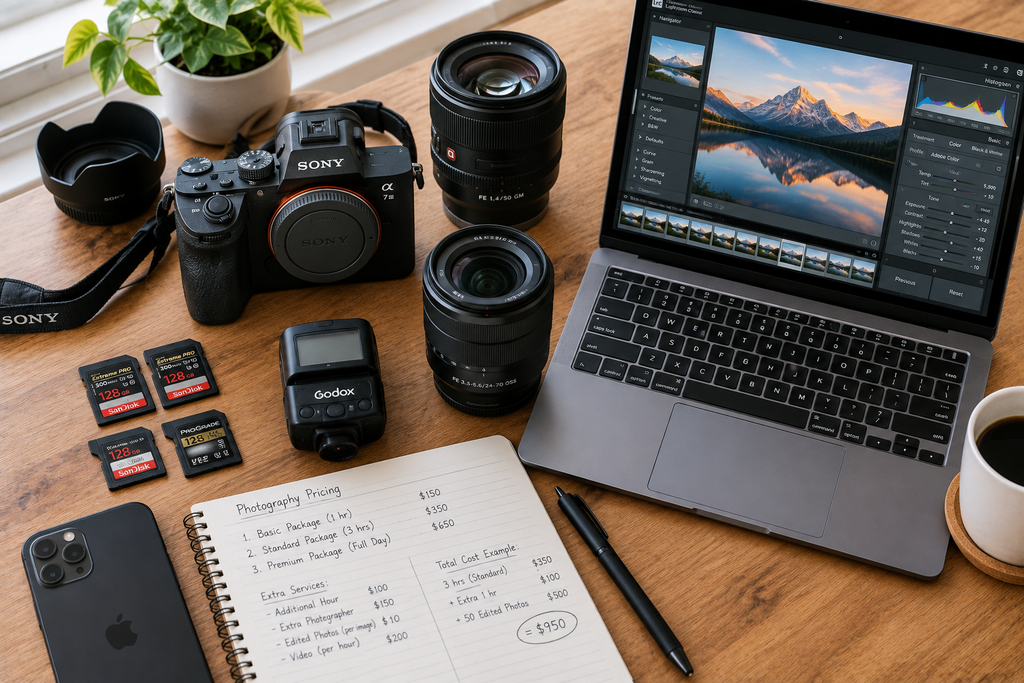
You don\’t need
every lens Canon has ever made. A solid camera body, one or two versatile
lenses, some backup storage because cards fail more than people think, and
basic lighting if your niche needs it. That\’s plenty to start. Get insurance
too, gear walks off or gets dropped more than you\’d expect. Everything else can
wait until the income actually justifies it. Going into debt for gear before
your first booking is a rough way to start a photography business. I\’ve
seen people do it and regret it within a year.
Handle the Legal Stuff Early
Nobody gets
into photography because they love paperwork, but this part protects you more
than any lens will.
●
Register your business (a sole
proprietorship is enough to start)
●
Open a separate business bank
account, tax season will thank you
●
Get liability insurance
●
Write real contracts and model
release forms
●
Track income and expenses from
your very first booking, not month six
If you want an
official rundown for registering a small business in the US, the Small Business
Administration has a decent step-by-step guide.
Price Like the Work Is Worth Something
New
photographers almost always price too low. Feels safer at first, more bookings,
less chance of scaring people off. But it usually just attracts clients who
haggle over everything, and you burn out inside a year. Check what competitors
in your area and niche actually charge before you set a number, then work
backward from your real costs, gear, editing time, travel, taxes. Figure out
whether package pricing or hourly rates fit your niche better. And stop
discounting yourself just to land a booking, it doesn\’t pay off the way it
feels like it should.
Roughly what
people end up spending to get going, at least from what I\’ve seen:
|
Expense |
Rough Cost |
Worth |
|
Camera body + lenses |
$1,500 – $4,000 |
The one place it\’s fine to |
|
Editing software |
$120 – $240 / yr |
Lightroom alone covers most |
|
Website & hosting |
$150 – $500 |
A simple site beats a |
|
Business registration |
$50 – $300 |
Varies a lot by state or |
|
Liability insurance |
$200 – $500 / yr |
Skip this and you\’re |
|
Marketing & branding |
$200 – $1,000 |
Can start near the low end |
These numbers
move around a fair bit depending on your city and niche. Close enough to budget
from though.
Build the Brand Before You Need It
By the time
clients start showing up, you want a portfolio site with your strongest work
front and center, Instagram and Facebook pages that actually get posted on, and
a Google Business listing if local search matters for what you shoot.
Testimonials help a lot too, collect them early, since people trust other
clients more than they trust an ad. If you already run a blog, link this back
to your pricing packages page and your portfolio so people have somewhere to go
next instead of just closing the tab.
Keywords That Actually Matter
Most clients
search before they call anyone. Worth working a few specific phrases into your
site naturally: “wedding photographer Lahore,” “affordable wedding photographer
in Lahore,” “newborn photography Lahore,” “how much does a wedding photographer
cost in Pakistan,” “book a photographer online.” Use them across your homepage,
service pages, blog posts, and your image alt text too, that last one helps
more with Google Images than people realize.
Getting Your First Real Clients
Honestly the
hardest part, and no amount of gear fixes it. Start with people you already
know, friends, family, coworkers who might need headshots. Run a limited-time
launch discount to get a few bookings on the calendar. Partner with venues,
planners, or agencies that overlap with your niche. Ask every happy client for
a referral and a review, every single time. Your first ten clients usually
market you better than any ad you\’ll ever run.
Once Things Steady Out, Build Systems
Somewhere
around booking twenty, the shoot-by-shoot chaos catches up with you. That\’s
when a CRM helps, or honestly even a well-kept spreadsheet, just something to
track leads and bookings properly. Tighten your editing workflow so it stops
eating your whole week. Once things feel stable, that\’s the point to raise
prices, bring on a second shooter, or branch into a niche next door to yours.
For more on
the business side of this industry, Professional
Photographers of America runs certification programs and community
resources worth a look once you\’re past the early stage.
Know Exactly Who You\’re Shooting For
Every
photography business that lasts has a specific person in mind when they market,
not “everyone who might want photos.” Think about:
1.
Demographics — age, income,
location, life stage
2.
Psychographics — luxury or budget,
candid or posed, fast turnaround or artistic depth
3.
Where they spend time — Instagram,
Pinterest, local Facebook groups, wedding directories
4.
What triggers the booking — an
engagement, a new baby, a business launch, a house sale
The clearer
that picture is in your head, the less generic your marketing sounds.
Bottom Line
There\’s no
single trick to how to start a photography business. It\’s a sequence. Pick a
niche, get genuinely good, deal with the paperwork before it becomes a problem,
price yourself properly, and market consistently instead of only when you
remember to. Do that long enough and it starts carrying itself. Every
photography business you admire started with one client, one shoot, and someone
who just began instead of waiting to feel ready for it.
FAQs
1. How money do I need to start a photography business?
The cost to start a photography business can be very different for each person. A realistic amount is between $2,000 and $10,000 or more. This usually includes the cost of a camera and lenses which can be $1,000 to $5,000 for a starter kit. You will also need to pay for editing software, which can be $10 to $50 per month. You need a website and portfolio which can cost $10 to $30 per month. Then there are business licensing and registration fees, which can be $50 to $500 depending on where you live and what kind of business you have. You should also think about insurance, which can be $300 to $1,000 per year. Many photographers start small. Use the money they earn to buy new equipment.
2. Do I need to have an LLC to be a photographer?
No you do not need an LLC to be a photographer. Many photographers work on their own without an LLC. However having an LLC can help protect you if something goes wrong. It can keep your money and business money separate. This can be important if you are taking pictures of someone and something gets broken. An LLC can also make you look more professional and can help with taxes.. It depends on how much risk you are taking and how much money you are making. You should talk to an accountant or lawyer in your area to see what is best for you.
3. Can I take pictures of people in public?
In places yes you can take pictures of people in public. If someone is in a place and they do not have a reason to think they are private you can usually take their picture without asking.. If you want to use their picture to sell something you usually need to get their permission. The rules are different in countries and even in different states or provinces. Some places have strict rules about taking pictures of people. You should check the rules in your area if you plan to take pictures of people.
4. How much should I charge for my photography services?
If you are just starting out you might charge $50 to $150 per hour or $100 to $300 per session. This depends on where you live what kind of photography you do and how experience you have. It is common to charge at first and then raise your prices as you get more experience and build a portfolio. You should look at what other photographers in your area\’re charging and think about how much it costs you to take pictures. You should not charge little or it will be hard to raise your prices later.
5. How pictures can I take in an hour?
This depends on what kind of photography you\’re doing. If you are taking pictures of events or people you might take 100 to 300 pictures per hour. If you are taking pictures of a wedding you might take more. What is more important than how pictures you take is how many good pictures you take. Usually clients want 20 to 50 pictures per hour of photography.
6. How do photographers pay their taxes?
Photographers are usually considered self-employed which means they have to pay their taxes. They have to pay taxes on the money they make. Their business expenses, like equipment and travel. In the United States photographers usually have to pay taxes four times a year and file a form with their tax return. It is very important to keep track of how money you make and how much you spend on your business. You should talk to an accountant, in your area especially if you are just starting out because tax rules can be very different depending on where you live and what kind of business you have.