

Medical Billing Software for Small Businesses
A quick heads-up: This article about medical billing software for small businesses isn’t legal or medical advice. It’s simply based on what I’ve learned running a small practice. Always double-check with your own professional advisors.
Let’s Be Real About Your Billing Headaches
You opened your clinic to help
people. Not to fight with insurance companies at 10 PM.
But here we are. Paper piles up.
Claims come back denied for reasons nobody explains. You’re staying late again.
I’ve been there. I once spent
three hours tracking down a $75 copay that fell through a spreadsheet crack.
That’s when I finally gave medical billing software for small businesses a real
shot. Looking back? I wish I’d done it years sooner.
It’s not magic. Still, the righttool helps a lot. Let me show you what I learned – so you don’t make the same
mistakes.
So… What Is This Billing Tool Exactly?
Think of billing software for
small clinics as a translator. It sits between your practice and insurance
companies. It turns your notes into the exact format they need.
Here’s how it works: You see a
patient. You type in what you did – such as “99213” for an office visit or
“97110” for therapy. The software then builds a clean claim. It checks for
errors automatically. It sends the claim electronically. Finally, it tracks
everything until money lands in your account.
No more guessing. No more “did I
mail that?”
How It Feels Different Day-to-Day
Look at this real-world
comparison. Same clinic. Same patient volume. Different tools.
|
Step |
With the Software |
Doing It by Hand |
|
Patient check-in |
Scan insurance card → |
Write it down → call later |
|
Adding codes |
Software suggests |
Flip through a binder or |
|
Sending claims |
One click → submitted in 2 |
Print, fold, stamp, drive |
|
Getting paid |
Money auto-appears in your |
Type every check number |
|
Fixing denials |
Dashboard says “wrong |
Wait 3 weeks for a letter, |
The bottom line: You get paid in
days, not months. Consequently, your cash flow becomes much more predictable.
Small Clinics Bleed Cash Without Modern Tools
Medical billing software for small businesses helps clinics reduce claim denials and improve payment accuracy.
You might think: “We’re tiny. We
don’t need fancy software. Excel is fine.”
Here’s what actually happens.
One typo in a patient ID number? That claim is gone for 45 days. Meanwhile,
you’ve already done the work. You’re just waiting – for free.
By contrast, with the right
healthcare billing system, that typo gets caught before submission.
Three Ways Your Practice Wins Immediately
Medical billing software for small businesses helps reduce administrative workload and improve claim accuracy.
•
You get back 10+ hours a week – That’s time to see two
more patients or leave on time for once.
•
You stop losing revenue – Clean claims get paid. Denied
claims get fixed fast. Money stays.
•
Your staff spends less time on billing – No more
re-typing the same thing twice. One front desk person told me she saved eight
hours a week after switching.
I’ve watched solo practitioners
add $2,000–$3,000 a month to their bottom line just by switching to small
medical billing software. Same patients. Same prices. Just fewer mistakes.
Features That Aren’t Just Fancy Buttons
Many providers choose medical billing software for small businesses because it saves time and simplifies billing tasks.
Let’s skip the marketing fluff.
Here’s what you’ll actually use every single day in a practice management tool.

Automated Invoicing & Claim Creation
Visit ends. You click “save.”
The software builds the invoice automatically. Codes? Already there. Prices?
Already set. You don’t touch a thing unless something’s wrong.
Claim Tracking (GPS for Your Money)
Ever spent 45 minutes on hold
with an insurance company? This tool shows you a simple map: submitted,
received, reviewed, paid, denied. If denied, it tells you exactly why – not
some cryptic code.
Patient Records + Billing Together
No more digging through three
different folders for an insurance card. Patient history, balances, and contact
info all live together. Your front desk will appreciate this – a lot.
Simple Financial Reports
You don’t need an accounting
degree. See who owes you money, which insurance pays fastest, and how much came
in this month. It’s all on one clean page.
Real Changes You’ll Notice by Week Two
Many clinics rely on medical billing software for small businesses to speed up payments and reduce denials.
Most software promises a lot. In
reality, good clinic billing software shows results fast.
Cash Flow Improves Quickly
Claims go out electronically.
Insurance companies process them in 10–14 days instead of 30–45. That means
less waiting for rent money.
Faster payments = fewer cash
flow scares. This is why you can finally stop holding your breath every time
you pay bills.
Errors Get Caught Early
The software scrubs every claim.
Wrong birthday? Catches it. Missing a modifier? Flags it. You fix it in 30
seconds instead of waiting two months for a denial letter. The payoff: you save
hours of rework.
More Time for Patients
“Hold on, I have to finish
billing” happens less often. Your front desk can greet people properly. Your
nurses can answer questions. That’s the practical benefit that matters most, in
my experience.
The Ugly Truth If You Keep Doing It Manually
I’m not trying to scare you.
Nevertheless, you should know the real costs.
|
Problem |
What It Really Costs You |
|
Typing errors everywhere |
5–15% of claims denied. |
|
Insurance checks take |
60+ days waiting. Your cash |
|
No system to track denials |
Same mistake happens every |
|
Spreadsheet chaos |
HIPAA risk. Audit |
Every month you stick with paper
or basic spreadsheets, you leave money behind. I learned that the hard way –
and I don’t want that for you.
How to Choose the Right Tool Without Regrets
You don’t need a $500/month
enterprise system. Small practices need something different. Here’s a
checklist.
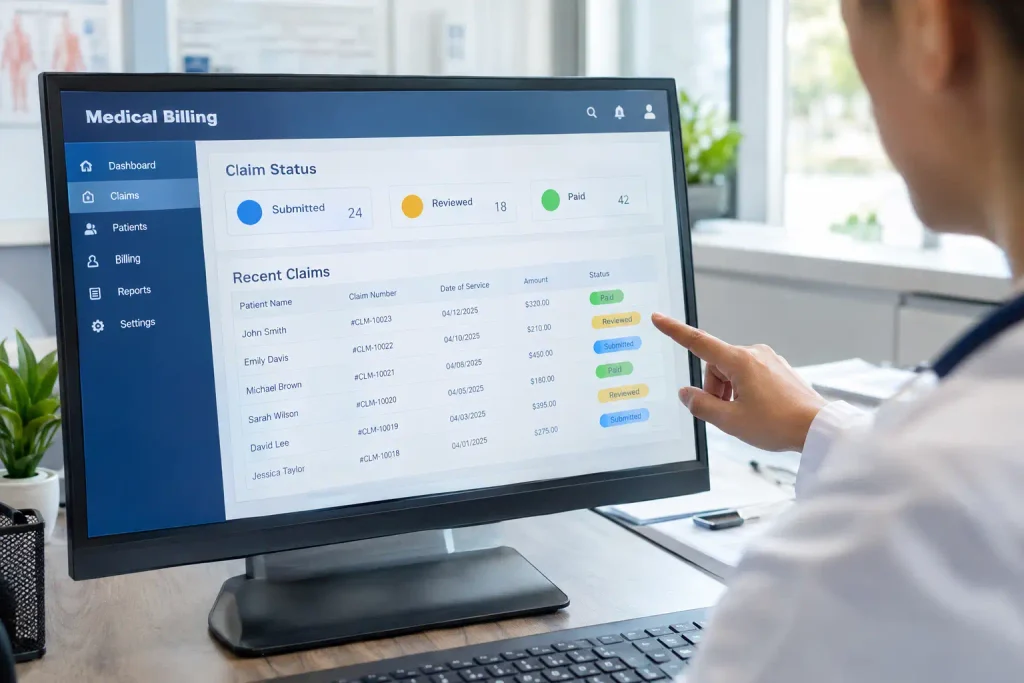
Key Factors – Short Checklist
•
Monthly cost – Look for $50–$150 flat fees. Avoid
“percentage of collections” unless you have very low volume.
•
Ease of use – If they promise three days of training,
that’s a red flag. Your staff won’t use it.
•
HIPAA compliance – Non-negotiable. Ask for their
Business Associate Agreement.
•
Customer support – Test their chat or phone line before
you pay. Slow support kills productivity.
One approach that worked for me:
Most offer a free trial. Take a real patient (no real name, use a test file)
and run it through. If it feels clunky after two hours, move on to the next
option.
Who Benefits Most? (Best Use Cases)
Not every clinic needs the same
thing. Even so, here’s where affordable medical billing systems help the most.
Dental Offices
Different PPO plans for every
patient? The software tracks which fee schedule applies to whom. No more
guessing or manual lookups.
Physiotherapy & Rehab Centers
Recurring visits, package deals,
copays every session – automated billing and reminders. PTs spend less time on
paperwork.
Solo Practitioners
You wear every hat. This becomes
your virtual biller. Many solo docs report saving 10 hours a week – time they
use to actually rest or see more patients.
Chiropractors & Mental Health Clinics
Superbills, insurance claims,
and patient statements – all in one place instead of three different systems.
That alone is worth the switch.
Wrapping Up – And a Simple Next Step
You didn’t go into medicine to
master insurance appeals. The right billing solution for small healthcare
providers exists so you can focus on patients – not paperwork.
A good tool is affordable,
straightforward, and often pays for itself in denied claims you never see. One
clinic owner I know recouped her software cost in the first month just from
catching three denied claims.
If you want to explore further:
•
Check our blog’s resources section for more guides on
small practice management.
•
Or look up recent comparisons of affordable billing
systems – there are several good ones updated for this year.
People Also Ask (Real Questions I Get All the Time)
1. Which billing software is best for a really small practice?
It depends if you also need
scheduling and patient records. Popular picks that work well for small teams
include Kareo (now Tebra), DrChrono, PracticeSuite, and RXNT. Try a free trial
before committing.Compare top-rated option on Capterra.
2. What’s the cheapest option that still works?
You can find solid plans
starting around $49–$75/month. PracticeSuite has a free tier (with paid
upgrades). RXNT and TheraNest both have plans under $100. Meanwhile, avoid
paying more than $150 unless you have very high volume.
3. Can I just use Excel?
Technically, yes. But
realistically, don’t. Excel can’t submit electronic claims. It can’t scrub for
errors. And without strict access controls, it’s a HIPAA violation risk. I
tried it once. It was a mess.
4. What are CPT codes again?
CPT stands for Current
Procedural Terminology – a five-digit code for what you did. For example, 99213
is a standard office visit. Insurance uses these codes to decide how much to
pay.
5. What mistakes should I watch for?
Most common ones I’ve seen:
•
Wrong patient birth date or ID number
•
Missing or wrong CPT modifier (like -25 or -59)
•
Code mismatch – CPT doesn’t match the diagnosis code
(ICD-10)
•
Forgetting to check insurance eligibility before the
visit
•
Sending the same claim twice by accident.
In short, medical billing software for small businesses is a key tool for improving clinic efficiency and cash flow.